
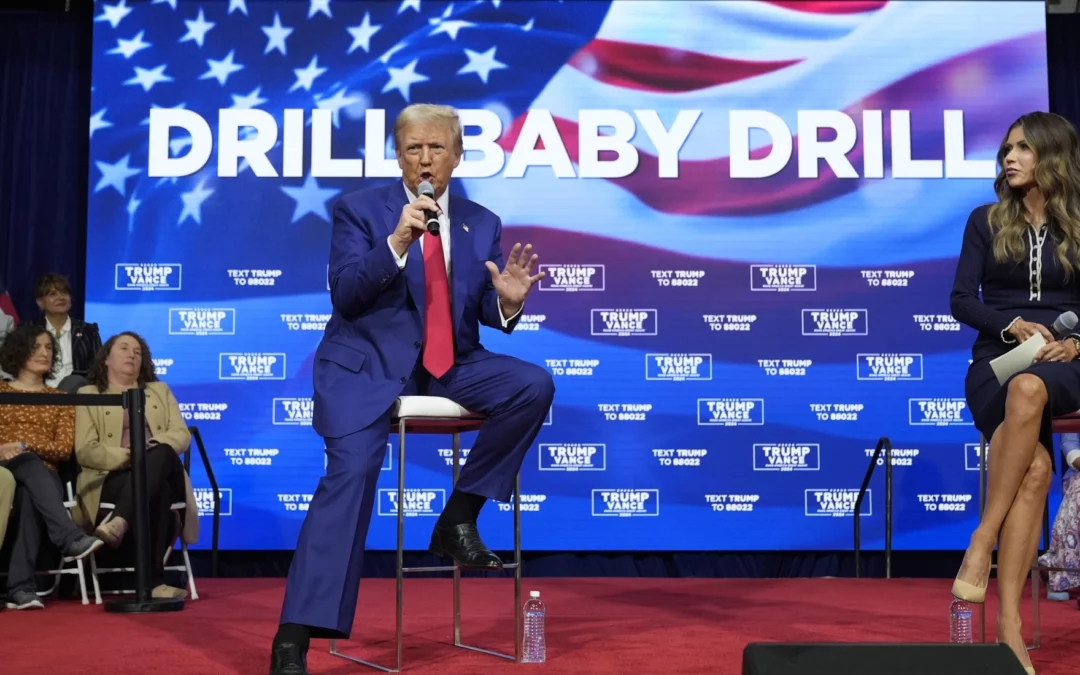
During the 2024 Presidential campaign, Trump met with about two dozen oil executives at Mar-A-Lago. He said, if you give my campaign a billion dollars, I’ll end Biden’s “war on oil.” Collectively, they gave nearly $220 billion, most of it to Trump and various GOP candidates. The return on their “investment” has been nothing short of outstanding.
Trump has delivered hundreds of billions of dollars in favors to the industry, including tax breaks and subsidies that will cost the U.S. taxpayer $80 billion over the next ten years, access to more federal land and waters, a major rollback of environmental regulations, the suppression of competition from clean energy technologies, access to Venezuela’s oil reserves, and of course, the very profitable Iran war. No one has stopped him.
True, Biden may have pushed “green energy” far more than the oil companies would have liked, and was noticeably tougher on coal, oil and gas than his predecessors, especially early in his term. He paused new federal leasing, tightened leasing rules and royalties, and pursued climate-oriented regulation, yet U.S. oil production still reached record highs during his presidency.
Some kind of easing of reliance on fossil fuels seems like a sensible policy in a warming world, which has its costs to many people in the U.S., and abroad. The World Economic Forum estimates the cost at $16 million per hour. But Trump and the fossil fuel companies don’t seem to care, and for less than a quarter of a billion dollars (all legal campaign contributions), oil and gas companies are reaping benefits worth far more.
Although the bribery was not a classic “quid pro quo,’ the One Big Beautiful Bill Act was described by multiple outlets as giving the oil and gas industry major wins: more leasing, lower royalties, faster permitting, and tax treatment favorable to fossil fuels, while cutting back incentives for wind and solar. One analysis said the legislation “addresses many of the leading objectives of the oil and gas industry,” while another said it was “chock full” of items from the industry’s wish list.
Trump’s efforts to disfavor renewables (for example, his “war on windmills”) go well beyond favoring oil and gas; incredibly, he has ordered 900 deep sea ocean sensors will be pulled out of the Pacific and Atlantic oceans off the coast of Washington Oregon Alaska North Carolina and Greenland. The Ocean Observatories Initiative (OOI) began full operations in 2016. The monitoring system was engineered to provide continuous, real-time climate data to global researchers for 25 years.
Jim Edson, a marine meteorologist who led the initiative, described the network as “the world’s most advanced continuously operating ocean observing systems.” To date, the OOI system has provided critical data used to understand how the ocean absorbs atmospheric greenhouse gases, how marine heat waves threaten commercial fisheries, and how sea levels trigger coastal flooding along the East Coast. Fixed 2,800 meters below the surface, the Irminger Sea moorings have been crucial to tracking dangerous changes occurring in the Atlantic Meridional Overturning Current (AMOC), a global current system that scientists fear could be seriously destabilizing to the world’s climate.
Moorings stretching west off Newport, Ore, and Grays Harbor, Wash, captured data about temperature, acidity and oxygen data used by the commercial fishing industry to anticipate devastating environmental shifts.
The infrastructure cost $370 million to build and required $48 million annually to maintain. By using remotely controlled robotic vehicles and underwater gliders to beam data directly back to labs onshore, the network allowed scientists to safely collect large amounts of information without launching risky, difficult, and expensive deep-sea boat expeditions every year.
Dr. Helen Palevsky, professor of earth and environmental sciences at Boston College, has used data from the OOI’s observation network to better understand how the ocean absorbs carbon dioxide. As she told the New York Times, “One of the real tragedies here is that collecting data effectively at this site was a huge engineering challenge, and it’s not the kind of thing where you can just leave your notes for the next person who comes in, there’s a lot of expertise that has the potential to be lost.”
The dismantling is the latest escalation in a broader effort by the administration to scale back federal climate science. Just last month, the administration announced an additional $1.1 billion in budget cuts targeting research on marine wildlife, ocean currents, and fish populations.
Both international and American scientists have criticized the decision to decommission the network.
As podcaster Jack Beatty has observed, this is a perfect example of “mindless” policy, and reminds me of the three monkeys: see no evil, hear no evil, speak no evil. If we don’t know the facts about ocean warming, we are in great shape, right? Mindless, indeed; Trump has been at war with any facts or truth that might question his versions of reality. His latest move is to replace experts with political appointees in approving grants for scientific research.
In addition to the legal bribe he asked oil executives to give him, Trump’s “war on woke” (including DEI, ESG, and anything to do with what he calls the great “hoax” of climate change) embodies a kind of fanaticism to further the burning of fossil fuels. No point in finding out what we’re doing to degrade the benefits of a stable ocean climate, right? When you know you’re right, why gather information that might contradict you?
Beyond “big oil,” business leaders of other industries should sit up and take notice that collaborating with Trump for short-term benefits does not create the conditions that will make America (or the world) any better, much less “great.” According to the Union of Concerned Scientists, phasing out fossil fuels is crucial for preventing severe climate impacts, saving lives, and avoiding billions in damages.
Trump often proudly proclaims that we are one of the “hottest” nations on Earth, but sadly, that’s become a literal truth, not a metaphorical one. And speaking of “truth,” when you add up the many ways in which Trump has assaulted the free press, universities that allow free speech, and his pressure on various institutions to portray U.S. history in a certain way –– a way that he approves of ––the administration’s push to ignore the reality of climate change is further evidence of another war that Trump is likely to lose: his war on truth itself.
Business leaders, beware: we will not remain a great nation, nor have a great economy, without looking at the world with much greater clarity and truth; this fossil fuel pay-to-play scheme is deliberately blind to the realities of global warming, and if such schemes become the new normal, we are (still) perfectly legal but very, very lost. We follow this fabulist fraud at our collective peril.