
In 7th grade a classmate came up to me at recess on the playground, puffed out his chest, and proudly announced, “I’m in the Four F Club.”
I had heard of the 4H club (Head, Heart, Hands, and Health), though it was not prominent in my suburban commuter town. I bit. “What is that?” I asked. He smiled. “Find ‘em, feel ‘em, fuck ‘em, forget ‘em.” Then he walked away.
I barely knew the basics of sex, much less love, but it was yet another message of “how to be a man” back in the 50s and 60s. In brief, the message was to be strong, athletic, good-looking, and don’t allow “weak” emotions like sadness, guilt, and self-doubt keep you from having your “fun” with “the weaker sex.”
As baseball was then “the national pastime,” during high school my chums and I had baseball metaphors for “making out” with girls. Getting to first base meant kissing (preferably more than just lips), and second base was “feeling up” a girl’s breasts (preferably underneath her clothing). Third base was touching unclothed below the waist, with hands or tongue, and a home run circled all the bases: sexual intercourse! Score!
For many guys, sex was a kind of game, and certainly not about soulful connections with a special woman. I can remember in my first year of teaching at a college in North Carolina how one of my male students asked how my weekend was; “just fine, thank you.” When I asked him about his own, he was pleased to relate that on Saturday night he went to the women’s dorm, knocked on several doors, and “scored” on the fifth try, when he succeeded in “hooking up.”
I was reminded of the 4F club when I watched the first fifteen minutes of Louis Theroux’s 2026 Netflix film, Inside the Manosphere. In the first two minutes, one young man looks at you and proudly says, “I’ve personally fucked two thousand women. That’s quite an accomplishment.”
But “find ‘em, feel ‘em, fuck ‘em, forget ‘em” has never really left U.S. culture. In the 1980s, as comedian and author Danny McBride explains, major movies that made an impact on young boys’ mindset included Rambo: First Blood Part II, Commando, Cobra, and Die Hard. Critics and film scholars often point to these films as showcasing the “hard body” hero: violent, emotionally sealed-off, hyper-competent, and a lone-wolf heroism defined by dominance or revenge rather than vulnerability. Ads, movies, TV, and music still often reward the idea that men should be stoic, tough, and self-sufficient, while treating emotional openness as weak. Bottom line? Be strong, confident and commanding and get whatever you want.
Many young men exposed to U.S. culture from movies and social media find a kind of “identity” in hyper-masculinity, and in 2024, many young men’s votes went for Trump over Harris. Online manosphere groups have flourished, and influencers like Andrew Tate continue to make bank on promoting misogyny through “strength.” In today’s “manosphere communities,” vulnerability, sadness, fear, and dependency are slammed as “weak” emotions that young men should avoid. Asking for help means loss of status; showing vulnerability means you’re a “sissy,” sadness or depression means you’re not tough enough and lack manly character, fear is mocked as lack of courage, and need or dependence or, God forbid, needing a mental health therapist, is mocked as unmanly.
What is weird and unsettling now is that the Four F Club’s machismo has made its way into public policy. In the cover story of the June 2026 issue of the Atlantic, Helen Lewis writes about “masculinism.” Lewis argues that multiple strains of anti-feminism—from the Christian right, from the manosphere, and from Donald Trump—have coalesced and become a new and potent force in American political life: “Far from being a fringe belief system, masculinism has become the single most important force uniting the American right, bringing together an unlikely constellation of pastors, posters, senators, preachers, influencers, podcasters, and fanboys.”
U.S. voters ––frustrated by the 2008 financial crisis and its aftermath, growing inequality and a sense of U.S. cultural drift –– have been looking for a “strongman” to fix what ails our nation, and Trump’s braggadocio fit the anxiety and mood of many voters, especially young men. Trump famously said, “Only I can fix it.” But lone-wolf heroism over cooperation, along with using threats and violence as your principal problem-solving tool has not served us well.
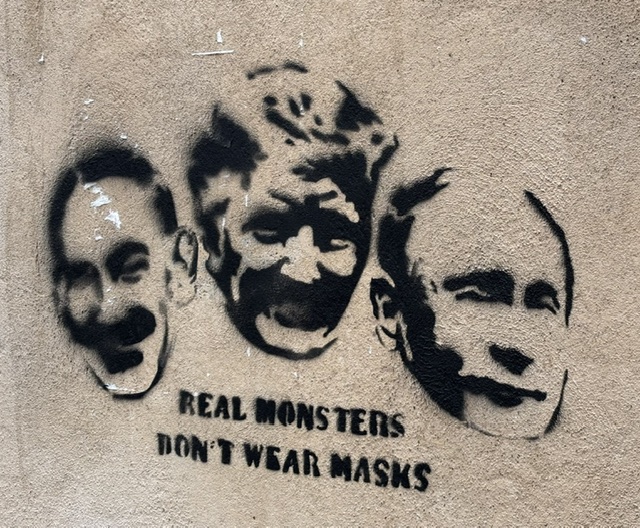
It hasn’t served other nations well, either. Consider Putin, Trump, and Netanyahu, pictured above, with the graffiti inscription my wife and I saw in Toulouse, France last fall: Real Monsters Don’t Wear Masks. It is true that Trump is very “transparent” –– we know (or should know) who he is and where he’s coming from: he will use fear, violence and threats of violence to get what he wants. This is true of Putin and Netanyahu as well. But after all the post-October 7 violence (some, with justification, will claim genocide) by Israeli forces, directed by Netanyahu, Israel is becoming a pariah state. Putin is not making Russia greater, nor is Trump making “America” great again by resorting to military, legal, and economic threats or actual violence.
Masculism and the manosphere are manifestations of the Four F Club’s motto, which is explicit about dominating and exploiting weaker individuals. The motto is a perfect metaphor for the militaristic exploits of Trump, Putin, and Netanyahu, exploits that signal a revival of imperialism and masculine mercantilism: grab what you want, make no apologies, and feel nothing for the victims of your own aggression, and move on to the next conquest.
This is barbarism, pure and simple. As the Israeli historian Yuval Noah Harari wrote in Sapiens (2015), relation to medieval notions of honor and the barbaric celebration of conquest, “What is better in life than to see your enemies flee before you, and their pretty daughters tremble at your feet?” And we know what came next in this “honorable” but barbaric moment where the wielder of weaponry is triumphant: fuck ‘em and forget ‘em.” Those pretty daughters are trembling because the conqueror has no intention of being kind or making a beautiful, happy family with them. Before being elected in 2016, Trump told Billy Bush on Access Hollywood, “And when you’re a star, they let you do it. You can do anything,” famously adding, “Grab them by the pussy.” Nor was this just “locker room talk.” With E. Jean Caroll, Trump was not convicted of “rape” but rather sexual assault, under the criminal trial standard of “beyond a reasonable doubt.” While such instances are recent, the ancient, barbaric impulse is not.
But commanding and exploiting others, whether by fame or by force, negates the very notion that all of us have a rightful place on this planet, or that (from our Declaration of Independence) that all men are created equal. Equality, Trump has decided, is for suckers; Trump has realized the ultimate male fantasy: “the most powerful man in the world.” In his interviews with Maggie Haberman and Jonathan Swan of the NY Times, Trump showed them a list of the most powerful figures from history, “and then explained why he thought their power paled in comparison to his, since they lacked global reach.
Rattling off names including Alexander the Great and William the Conqueror, the president noted, “They didn’t have airplanes,” according to the book. He continued, reciting more names: Napoleon, Hitler, Mao, Stalin. Those leaders, Mr. Trump told the authors, “. . .maintained power through fear.” He sees himself as even more powerful, just because he heads “the hottest country” in the world and has the largest military at his command, a military that is now being systematically groomed to be “lethal” and “loyal” to him.
This “mentality” explains his domination claims on Greenland, Canada, Venezuela, Cuba, and now Iran. But even the most militarily powerful person in world history, which Trump fancies himself to be, you cannot fabricate reality or bend it to your will. And even if you could, it would not make you a better human being.
I’ve often wondered whether Trump is happy –– he will smile now and then, but the photo he chooses for his second Presidential portrait is of a scowling, menacing man. It may be that his only “pleasure” is watching other leaders (and even billionaires) grovel to ingratiate themselves. Bezos and Zuckerberg certainly have. His Cabinet meetings are a mock-up of the old mob boss movies of the 1950s, where all the sycophants he appointed for their loyalty will tell him just how amazing he is. Even then, he tends to nod rather than smile.
Finally, we should circle back to the principles of the Four H Club. They are about improving the head (thinking critically, making decisions, and learning life skills, the heart (showing loyalty, caring for others, and developing emotional intelligence), the hands (volunteering and giving back to the community) and health (taking care of one’s physical and mental well-being.) There may be no person in “the hottest country on Earth” that better exemplifies the rejection of these values than our President, Donald J. Trump.
That so many U.S. voters chose him as a leader, twice, should remind us that as a nation, we are not so exceptional after all. We can only hope our broken political and legal system raises up someone who has not only better health, physically and mentally, but also cares for others and for a greater sense of unity and community. May it be so.